
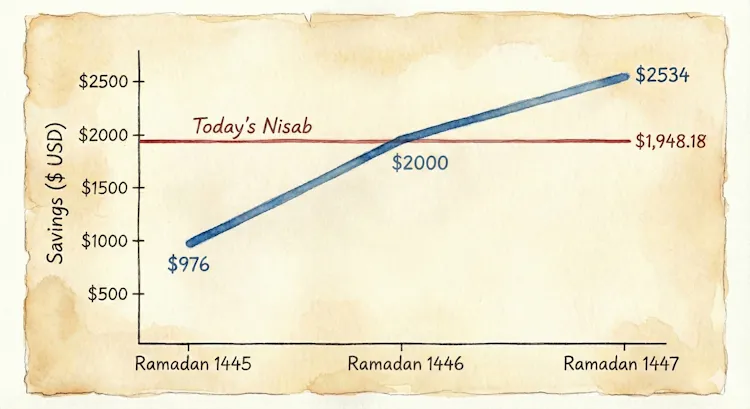
Nisab: The Minimum Wealth Threshold for Zakat
Nisab (al-nisab) is the minimum amount of wealth a Muslim must possess before being obligated to pay zakat. If your total zakatable wealth equals or exceeds the nisab threshold and you have owned it for one lunar year, you owe 2.5% of that wealth as zakat. If you possess less than nisab, you are not liable for zakat on wealth.
The nisab triggers the obligation; it does not function as an exemption. Once you reach nisab, you calculate zakat on your entire zakatable wealth, not just the amount exceeding the threshold, so that someone possessing exactly the nisab amount owes 2.5% on the full sum.
The Function of Nisab
The nisab represents the point at which Islamic law considers a person financially self-sufficient. Zakat was legislated as mutual relief among Muslims, and one who is poor cannot be obligated to provide relief to others; the wealthy are obligated to assist those in need. The Sacred Law established the nisab as the minimum threshold because possessing this amount generally indicates a person is self-sufficient for the year.
The nisab varies by type of zakatable wealth. For livestock, the thresholds are five camels, thirty cattle, or forty sheep. For agricultural produce, the threshold is five awsuq (approximately 653 kilograms). For currency and trade goods, the nisab is measured by the equivalent of either gold or silver.
The Gold and Silver Nisab Standards
The nisab for currency is based on the weight of precious metals. The gold nisab is 20 mithqals, equal to 85 grams of gold. The silver nisab is 200 dirhams, equal to 595 grams of silver.
These measurements come directly from prophetic hadith. The Prophet (peace be upon him) said: "There is no charity on what is less than five awaq of silver." One uqiyyah equals forty dirhams, so five awaq equal two hundred dirhams. The legal dirham (al-dirham al-shar’i) equals seven-tenths of a mithqal, approximately 2.975 grams, so that 200 dirhams equal 595 grams of silver.
Choosing a Nisab Standard
Because precious metal prices fluctuate daily, the dollar equivalent of nisab changes constantly. You must choose whether to use the gold or silver standard to determine your nisab threshold.
SimpleZakatGuide recommends using the silver nisab for several reasons:
- Prophetic precedent: Silver was the most common currency during the Prophet’s time and is the most frequently mentioned standard in hadith.
- Broader benefit: The silver nisab is lower than the gold nisab, meaning more people reach the threshold and contribute to the welfare of the poor.
- Classical preference: Silver served as the practical standard for most transactions in classical Islamic societies.
The silver nisab typically translates to a significantly lower dollar amount than the gold nisab. At current market rates, the silver nisab is generally in the range of $500–700, while the gold nisab falls in the range of $6,000–8,000, a gap wide enough to determine whether a person is obligated to pay zakat at all.
The Silver and Gold Price Differential
The silver nisab produces a lower dollar threshold because of the historical and current price ratio between gold and silver. In the early Islamic period, the exchange rate between gold and silver was relatively stable, but over centuries gold has become significantly more valuable relative to silver. The fixed weights (85 grams of gold versus 595 grams of silver) reflect the original nisab standards, but when converted to modern currency they produce different thresholds because the metals’ relative values have changed.
The gap reflects the fact that different metals served different functions in the classical economy, and the lower silver threshold aligns with the principle that zakat should be accessible to a broad base of Muslims who have achieved basic financial stability, not just the wealthy elite.
Determining Whether Nisab Is Reached
To determine whether you owe zakat:
-
Find the current nisab value. Multiply the current price per gram of silver by 595 grams.
-
Calculate your total zakatable wealth. Add together all assets subject to zakat: cash in hand and bank accounts, gold and silver (by weight, not sentimental value), investment accounts (stocks, bonds, mutual funds), business inventory and trade goods, money owed to you that you expect to collect, and retirement accounts (according to the position that treats them as accessible wealth).
-
Deduct immediate debts. Subtract debts that are currently due or will become due within the immediate future. This includes credit card balances, utility bills currently due, taxes owed for the current year, personal loans that are callable, and installment payments due within the next 12 months. Do not deduct long-term deferred debts such as the total balance of your mortgage, the full amount of student loans, or car loans.
-
Compare to nisab. If your total zakatable wealth (after any applicable deductions) equals or exceeds the nisab threshold, and you have owned this wealth for one complete lunar year, you owe zakat at 2.5% of the total amount.
-
Calculate your zakat. Multiply your total zakatable wealth by 0.025 (which is 2.5%). This is the amount you owe.
Nisab for Mixed Portfolios
When you own multiple types of zakatable assets, such as cash, gold jewelry, stocks, and business inventory, you combine all of them to determine whether you have reached nisab. You do not need to reach nisab in each category separately. If your total across all categories reaches the silver nisab threshold, you owe zakat on the entire amount.
Nisab and the Full-Wealth Calculation
Zakat is owed on the full amount of zakatable wealth once nisab is reached, not merely on the portion exceeding the threshold. The nisab marks the point at which the obligation begins; it does not carve out an exempt portion below it.
The classical sources are explicit on this point. The majority of jurists held that there is no waqss (exempt increment) in gold and silver, meaning that if you possess 210 dirhams, you owe zakat on all 210, not just the 10 above the 200-dirham threshold.
Nisab and the Lunar Year Requirement
Reaching nisab is one condition for zakat to be due, but not the only one. You must also own nisab-level wealth for one complete lunar year (hawl). If your wealth dips below nisab at any point during the year, the year resets when you return to nisab.
However, you do not need to maintain the exact same assets throughout the year. The requirement is that your total zakatable wealth remained at or above nisab continuously, even if the specific assets changed.
Verifying Nisab on Your Zakat Anniversary
Because silver prices fluctuate, you should check the current nisab value when your zakat anniversary date approaches. A nisab that was $650 last year might be $700 this year, or $600, and this affects whether you have reached the threshold.