
Nisab: Your Complete FAQ
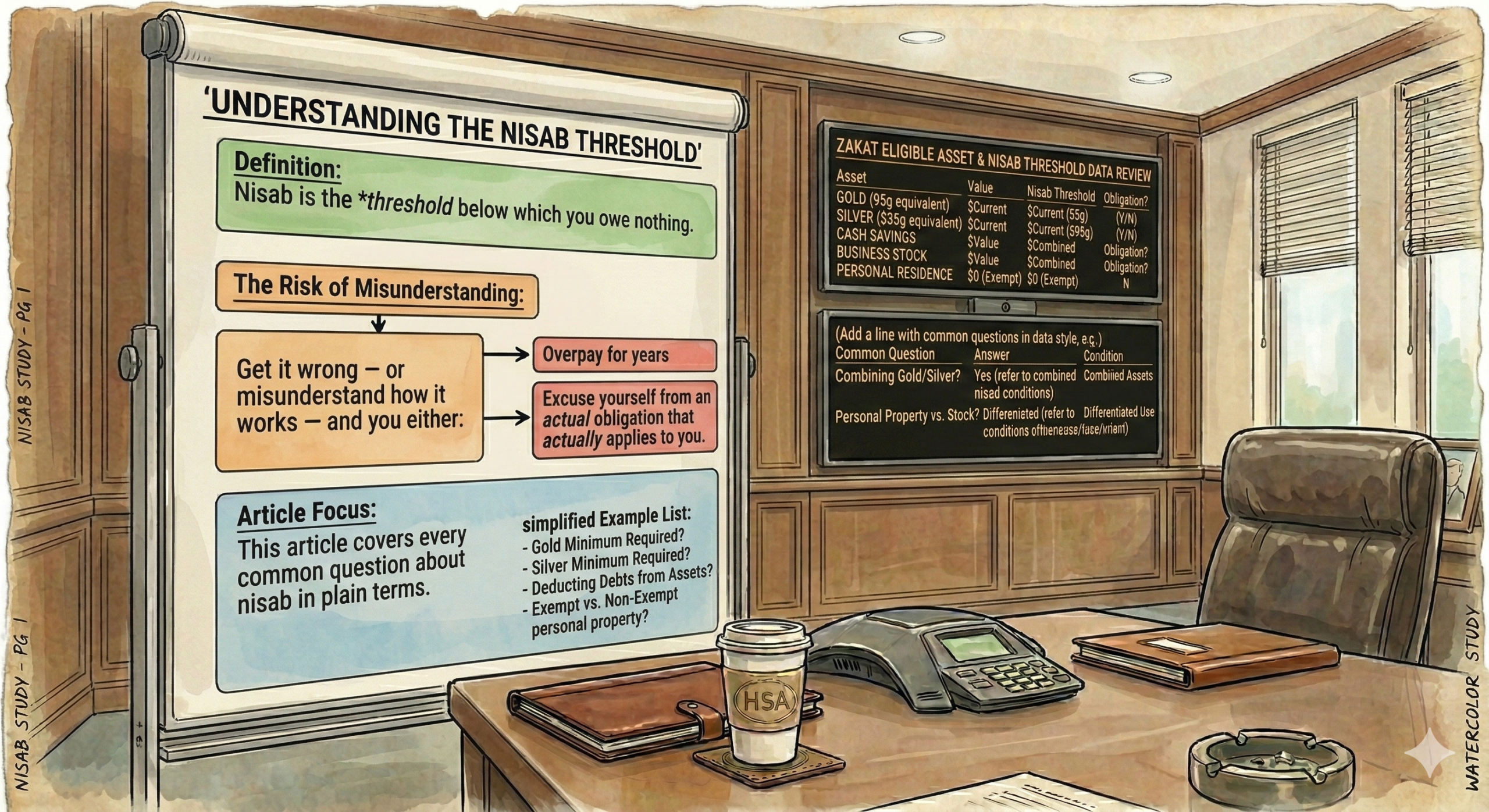
Nisab is the threshold below which you owe nothing. Get it wrong or misunderstand how it works and you either overpay for years or excuse yourself from an obligation that actually applies to you. This article covers every common question about nisab in plain terms.
What Is Nisab?
Nisab is the minimum amount of zakatable wealth a Muslim must hold before zakat becomes obligatory. If your total zakatable assets (after subtracting immediately due liabilities) fall below the nisab on your zakat date, you owe nothing. If they meet or exceed it, you pay 2.5% on the entire amount not just the portion above the threshold.
This is not a deductible. It is a gateway. Either you cross it and owe zakat on everything, or you do not cross it and owe nothing. There is no partial obligation triggered by a partial crossing of the line.
Why Does Nisab Exist?
Zakat was designed to transfer wealth from those who have excess to those who do not. The nisab ensures that only people who genuinely have surplus wealth above basic needs are included in that transfer. Someone living hand to mouth, even if they technically have some cash on hand, is not the target of this obligation.
The Prophet, peace be upon him, described zakat as something taken from the wealthy and given to the poor. Nisab operationalizes what "wealthy enough to give" means in practical terms.
How Is Nisab Calculated?
Nisab is defined in terms of physical weight, either gold or silver, and is converted to your local currency using today’s market price.
Gold nisab: approximately 85 grams (the Hanafi school specifies 87.48 grams). Multiply the current price per gram of gold by 85 (or 87.48 if you follow the Hanafi school) to get today’s gold nisab in your currency.
Silver nisab: approximately 595 grams (the Hanafi school specifies 612.36 grams). Multiply the current price per gram of silver by 595 (or 612.36) to get today’s silver nisab.
Simple Zakat Guide fetches live precious metals prices and calculates both figures automatically on Step 1 of the calculator.
Gold Nisab vs. Silver Nisab: What’s the Difference?
The gold nisab is currently much higher than the silver nisab in dollar terms. As of early 2026, gold nisab is roughly 7,000–8,000 USD, while silver nisab sits around 350–400 USD. This gap exists because the relative market prices of gold and silver have shifted dramatically since the time of the Prophet, peace be upon him — silver was the everyday currency of the Muslim world, and the two metals held a much closer value ratio then.
The Gold Nisab: Some contemporary scholars use the gold nisab on the grounds that gold has historically been the more stable store of value and remains the standard reference for monetary wealth in Islamic jurisprudence.
The Silver Nisab: Many other scholars, and I am among them, use the silver nisab. The reasoning is threefold.
- First, silver was the dominant transactional currency during the prophetic era; the dirham was the coin of commerce, and the overwhelming majority of hadith on zakat thresholds reference silver quantities.
- Second, when you examine the nisab for different zakatable assets across the classical texts, their implied values at the time of the Prophet align more consistently with the silver nisab than the gold nisab.
- Third, a lower threshold means more wealth reaches those in need and there is no fiqh principle that argues in favor of a higher threshold.
Simple Zakat Guide uses the silver nisab as the default because it is the more conservative and inclusive standard. Paying zakat when you might not strictly owe it under the gold standard is not a harm; failing to pay when you do owe it is.
Do you have to use silver? No. If you follow a scholar or school that holds the gold nisab position, calculate accordingly. The disagreement is legitimate. What you should not do is switch standards year to year based on whichever one results in a lower obligation; that is selective application of a legal disagreement for personal benefit, which nullifies Ikhlas.
Does Nisab Change?
Yes. Because nisab is anchored to the weight of gold or silver, and precious metals prices fluctuate daily, the dollar (or pound, ringgit, rupee) equivalent of nisab changes constantly. A nisab figure from last year is stale.
This is why the calculator uses live pricing. A fixed dollar amount circulating on social media is almost certainly out of date and may be significantly wrong.
You check nisab on your zakat date; the one day each year when you assess your wealth. You do not need to track daily fluctuations throughout the year.
What If I’m Right at the Threshold?
If your zakatable wealth on your zakat date is at or above nisab, even by a small amount, the obligation applies in full. There is no "rounding down" or grace zone below the threshold.
If you are genuinely uncertain whether you are above or below, the cautious position is to pay. The downside of paying when you were just below is trivially small (you have given a small amount in voluntary charity). The downside of not paying when you were just above is a missed obligation.
Common Misconceptions About Nisab
"Nisab is $X per year." No. Nisab is a commodity weight converted at today’s price. It changes with market prices. A fixed dollar figure is an approximation at a point in time.
"I use the gold nisab this year because it means I don’t owe anything." Choosing your nisab standard based on which one minimizes your obligation is not a valid application of scholarly disagreement. You should settle on a standard that is best for the poor and the needy, as Zakat is their right in your wealth.
"I’ve been using silver nisab for five years. This year gold is lower, so I’ll switch." The same problem in reverse.
"Nisab is calculated per family." Zakat is an individual obligation. Each adult Muslim calculates their own wealth against their own nisab separately. Your spouse’s wealth does not count toward or against your nisab.
"My wealth only needs to exceed nisab on one day." Partially correct: your wealth must exceed nisab on your zakat date, but it also must have been at or above nisab at the start of your hawl (the full lunar year preceding your zakat date).
What Counts Toward Nisab?
All zakatable assets combined are measured against nisab — not each category individually. You add up:
- Cash (bank accounts, physical cash, foreign currency equivalents)
- Precious metals (gold and silver held as investment or excess jewelry)
- Investments (stocks, funds — using the current zakatable value)
- Receivables (money owed to you that you expect to collect)
- Business assets (cash, inventory, receivables)
Personal use items like your home, your car, your household furniture, your personal jewelry do not count toward nisab and are not included in the calculation.